Sooner or later a kid in a house with no chimney does the math. No chimney, no Santa. Or worse: Santa comes down the neighbor’s chimney and your kid gets the neighbor’s leftovers.
Santa’s magic key is the answer a lot of families land on, and it is a good one. It is cheap, it takes ten minutes, and it turns a worried question into a small Christmas Eve job your kid gets to do. Here is how to make one, what to write on the tag, and how to stop it from falling apart the first time a sharp eight-year-old looks at it closely.
What is Santa’s magic key?
The short answer: Santa’s magic key is a key a family leaves out on Christmas Eve, usually on the front door handle or a hook by the door, so Santa can let himself in when the house has no chimney. The story goes that the key only works for Santa, only on Christmas Eve, and that he leaves it behind so the family can use it again next year. Most families make their own from an old key, a ribbon and a tag.
That is all it is. No app, no subscription, no batteries. Just a key and a story good enough that a kid stops worrying and goes to bed.
Who needs one (more families than you think)
- Apartments and condos. The classic case. A kid in a third-floor apartment has noticed there is no roof to land on.
- Houses with a fake or blocked fireplace. A gas insert with a glass front is not an entrance. Kids notice the glass.
- Houses with a real fire on Christmas Eve. Some kids worry about Santa’s boots more than his schedule.
- Christmas away from home. At Grandma’s, in a hotel, at the beach house. “How will Santa know we’re here?” is a real bedtime question, and a key hung on the right door answers it.
- The kid who just learned how chimneys work. Every family gets one eventually.
How to make a magic key in ten minutes
- Pick the key. Big and old-fashioned beats small and real. A skeleton key from a craft store, a thrift shop or a flea market looks like it opens a door at the North Pole. A spare key from your own keyring looks like it opens your car, because it does.
- Make it look like nothing else in the house. Gold or red spray paint, a little glitter if you can live with glitter, or nothing at all if the key is already old and interesting.
- Tie on a ribbon. Red or green, long enough to hang on a door handle or a nail by the door.
- Add a tag. A small card, punched and tied to the ribbon. This is where the magic actually lives, so give it a minute. Wording ideas are below.
- Sign it as Santa, not as you. Your kid has seen your handwriting on a few hundred lunch notes. Learn how to sign as Santa so the tag does not give the whole thing away.
Make it once and keep it. The key coming back every year is half the fun.
What to write on the tag
Short beats clever. A tag is about the size of a business card, and the kid reading it may be four. Borrow one of these, or mix two.
For little ones (about 3 to 5)
“This key is for Santa. It only works on Christmas Eve, and only for him.”
“No chimney? No problem. Love, Santa”
“Hang me on the door. Santa will do the rest.”
For bigger kids (about 6 to 8)
“Santa’s Magic Key. Works one night a year, on one door, for one very busy man.”
“If you are reading this, you are not Santa. Please put the key back on the door.”
“Santa used this key at your house. He left it here so you can use it again next year.”
A short rhyme (write your own, or borrow this one)
“Our house has no chimney, no place for a sleigh,
So here is a key for the night Santa stays.
It opens our door for one night of the year,
Then hangs on the tree till next Christmas is here.”
For the morning after, swap the tag for a new one in the same Santa signature: “Thank you for the key. I left it on the tree for next year. Santa.” The kid finds a different tag than the one they hung up, and that is the kind of detail that gets told at school.
Want Santa to leave a longer note than a tag can hold? Our sample letters from Santa have lines you can borrow for every age.
The Christmas Eve routine
The key is better as a ritual than as a decoration. A simple version:
- December, early on: the key comes out of its box. Kids like seeing it again. It can live on the tree until Christmas Eve.
- Christmas Eve: your kid hangs it on the front door handle, or the door Santa is most likely to use (some kids have strong opinions about this). Cookies out, lights off.
- After bedtime: move the key. On the tree, on the mantel, on the kitchen table next to the cookie plate. Somewhere a kid would never have put it.
- Christmas morning: the key has moved, the tag has changed, the cookies are crumbs. That is three pieces of evidence before anyone opens a present.
If you want more where that came from, here are 12 ways to leave proof Santa was here that a skeptical kid can actually check.
The mistakes that give you away
- A key that fits your door. If your kid tries it in the lock and it works, Santa is now “a person with our house key,” which is a much shorter list of suspects.
- A key from your own keyring. They know your keys. Kids who are not allowed to touch your keys know your keys best of all.
- The tag in your handwriting. Covered above, and still the number one way the magic leaks.
- The craft store bag in the recycling. Evidence goes in the outside bin, the week before.
- Forgetting to move it. A key still hanging exactly where they left it on Christmas morning is a hard one to explain.
When a skeptic asks the hard questions
Somewhere around seven or eight, the key gets cross-examined. A few honest, magic-friendly answers:
- “Can’t a burglar use it?” “It only works for Santa, and only on Christmas Eve. On any other night it is just a key.”
- “How does Santa get into houses that don’t have a key out?” “Santa has his ways. The key is our way of making it easy for him.”
- “Is the magic key real?” “What do you think?” Asked kindly, this is not a dodge. Kids who ask often want to talk about what they believe, not get a ruling. If the bigger question is coming, read what to say when your kid asks if Santa is real before you answer.
Questions
Where do you hang Santa’s magic key?
Most families hang it on the outside or inside handle of the front door on Christmas Eve. Inside is safer if you live somewhere windy or busy. Some hang it on the tree all December and move it to the door on the 24th.
What do you do with the key after Christmas?
Keep it. The story says Santa left it so you can use it again next year, and a key that comes back every December becomes a family tradition all on its own.
Does it need to be a real key?
No. Any key that looks old and important works. A real key to your house is the one kind to avoid.
What age is the magic key for?
Any age that still believes. Little kids love hanging it up. Older kids love checking whether it moved.
Can we do the key and still have a chimney?
Sure. Plenty of families with a chimney use one anyway, because the hanging-it-up part is fun. Santa is not picky about doors.
The key gets Santa in. The letter proves he knows them.
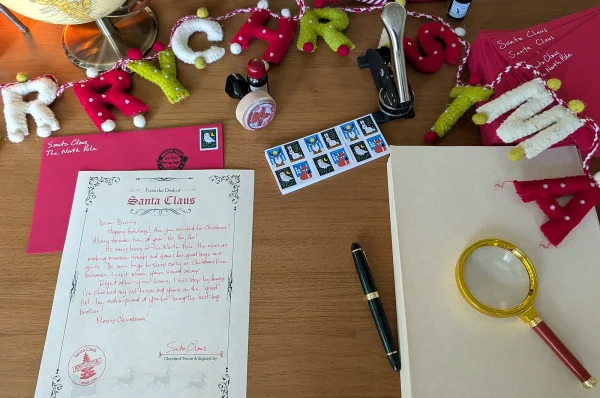
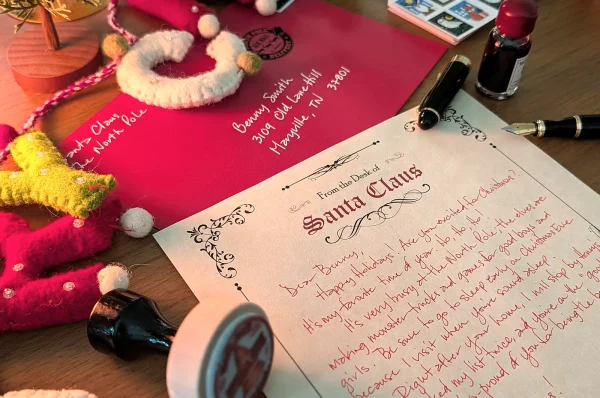
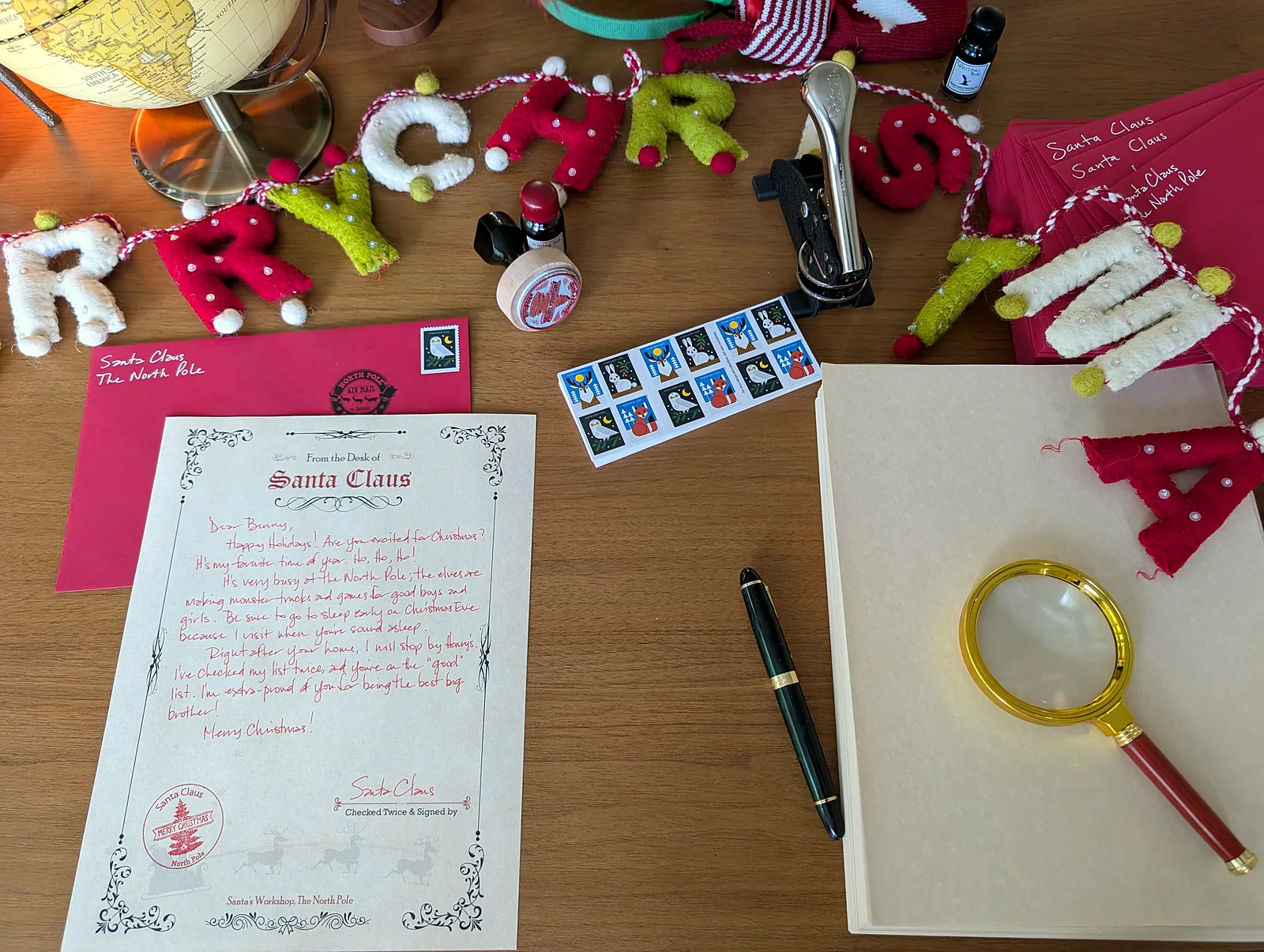
A key answers “how does he get in?” A letter in the mailbox with their name on it answers the bigger question: “does he know who I am?” Our letters arrive in a red 6×9 envelope, hand-addressed in white Christmas ink, with a North Pole return address and a real stamp.
- The free printed letter: printed on cream parchment, with your child’s first name, in the same hand-addressed red envelope. Free letter. $6.99 shipping. Order by December 12 and it arrives before Christmas. Start with the free letter.
- The handwritten letter: every word written by hand in red ink on cream parchment, with their name, their best friend’s name, what they are hoping for, and something they did this year worth noticing, hand-stamped with Santa’s North Pole stamp. Order by December 12 and it arrives before Christmas, or a full refund (US addresses). Order the handwritten letter from Santa.